
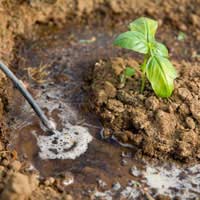
What’s the best way to water your garden? There are many watering options to choose from including watering cans, hoses, sprinklers, rain barrels, soaker hoses, drip irrigation and container watering. Methods differ in cost, labour involved and how well they conserve water. A combination of devices may be used to create the most effective plant watering system.
Jump To...
Using Watering Cans In The Garden
For a small garden, a watering can may be all the plant watering system you need. Get a good‐quality, rust‐proof metal watering can that’s large enough to save trips to the faucet, but small enough to be easily carried when full, since vegetable gardens take plenty of water. The spout should be fitted with a “rose” – a perforated, flattened, end attachment. A brass rose is more durable than plastic.
Hoses As Plant Watering Systems
For all but the smallest garden, a hose is a necessity for watering . Rubber hoses last longest, but rubber hoses with a vinyl exterior are sturdy and cost much less. Get a good brass nozzle for general watering and a “wand”, which has a long handle and different settings for “mist”, “soak”, etc. for different vegetables in the garden. A wand with a built‐in water shutoff is handy – it saves trips back to the faucet.
If you have a large garden – or several vegetable gardens ‐ a ‘Y’ connector or four‐way tap to attach multiple hoses to one faucet is also handy as a plant watering system. “Quick‐connect” hose fittings to attach two hoses together are another time saver. The connectors are screwed on to the threaded end of each hose (and the faucet), and enable you to connect and disconnect hoses with a simple “snap‐lock” mechanism. Buy connectors with a built‐in shut off feature, which allows you to disconnect attachments without turning off the garden faucet. Brass connectors will last longer.
Hose repair kits are good to know about in case you accidentally run over the hose with your lawn mower. They’re easy to use and can save replacing an expensive hose.
Using Sprinklers In The Vegetable Garden
Sprinklers are attached to a hose and water from above. Readily available and commonly used on lawns, they’re not very efficient as a plant watering system in a vegetable garden as they lose a lot of water to evaporation. One estimate says that as little as 20 percent of the water actually gets through to the plants in the garden.
Types of sprinklers include oscillating sprinklers, impulse sprinklers, and rotating sprinklers. Oscillating sprinklers have a bar that cycles in an overhead fan pattern. Rotating sprinklers water in a circular pattern. With impulse sprinklers, water hits a pin or hammer, watering in a circular or semi‐circular pattern. Impulse sprinklers deliver a strong spray, cover a wide area in the garden, and water deeply closest to the sprinkler. Place a rain gauge or tin can in different locations in the garden to check that the appropriate amount of water is reaching each bed in the garden. The best type of impulse‐jet sprinkler for the vegetable garden is one that’s mounted on an elevated tripod, so it doesn’t hit nearby plants directly with its forceful spray.
When choosing a sprinkler, select one with an adjustable watering pattern that can be programmed to suit your garden needs. Patterns may be circular, semi‐circular, square, or rectangular. Note that you shouldn’t use a sprinkler if it’s windy, as the watering spraying pattern will be thrown off.
Making Use Of A Water Butt In The Garden
Rainwater has two advantages for the garden: it’s free and it doesn’t contain the chemicals found in tap water. Wooden or plastic water butts can be purchased from catalogues or garden centres. You can also make your own water butt using a recycled oak barrel from a winery or distillery, fitted with a wooden spigot (available at wine‐making supply stores) sealed with a silicon sealant. The water butt can be positioned under the gutter downspout to collect water from your roof. Put a lid on your water butt to keep mosquitoes from breeding in the standing water.
Soaker Hoses and Drip Irrigation As Plant Watering Systems
Soaker hoses are lengths of porous or perforated hose or tubing: water is emitted along the entire length of the hose. Some soaker hoses are flat and may be positioned with the holes upward to deliver a light spray (to water lawns, for example), or downward to soak into the soil (to water vegetables or flowers). Soaker hoses are positioned alongside plant rows in the vegetable garden or wound between plants, to deliver water just where it’s needed in the garden. Drip irrigation systems use emitters to water individual plants, and require more planning as a plant watering system in the garden. Soaker hoses and drip irrigation systems are initially expensive, but they’re extremely efficient for gardens. These methods can lower water usage by about 60 percent over a sprinkler system.
Container or Pitcher Watering In The Garden
One easy and inexpensive way to water your garden is to use container or pitcher watering as a plant watering system. You can buy specially‐designed clay pots, or make your own container out of recycled materials. A large, long‐necked wine bottle with a screw‐top lid can be used: punch holes in the lid, fill with water, and bury it neck‐deep beside the plant to be watered. A large recycled milk jug or other plastic bottle with several holes cut in the bottom can be used in the same way, buried in the ground next to the plants in the vegetable garden. Fill the bottle with water and the water will go to the roots, just where it’s needed. This method works well for large plants like squash.
Other Considerations
For a newly‐planted vegetable garden bed, use a watering can fitted with a rose or a watering wand set on a fine‐mist setting, so as not to wash away seeds.
By combining a water butt set up on blocks, a spigot and irrigation tubing, you can set up a gravity‐feed watering system for your garden that costs nothing to operate.
Determine your watering needs and study the options before you buy. Careful planning can save you both water and time and ensure that your plants get just the amount of water they need!
