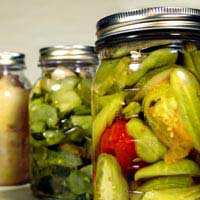
Why not try canning your own tomatoes or other vegetables for use in winter soups, stews, and sauces? Home canning isn’t as hard as you might think, but it does require some specialised canning equipment and good organisation.
Jump To...
What is Vegetable Canning?
Canning means preserving vegetables or fruits by sealing in airtight cans or jars. To the home gardener, however, only glass jars are practical. In home canning, food is heated ‐ or processed ‐ for a specified time in a closed jar and hermetically sealed with a two‐piece cap. Heating the jar expels air and halts decay. As the jar cools, the lid seals onto the rim and creates a vacuum.
All fresh foods contain enzymes as well as naturally occurring microorganisms including molds, yeasts and bacteria. The purpose of canning vegetables is to limit the growth of these organisms and enzymes.
The Ways To Can Vegetables
Vegetables for canning fall into two categories: high acid or low acid. High‐acid foods, such as tomatoes, are processed using a boiling‐water canning method at a temperature of 212°F (100°C). With this method, packed jars are placed in a rack and lowered into a large pot of boiling water. Boiling‐water processing is easiest for the home canner.
Low‐acid foods must be preserved with a steam‐pressure canner at a temperature of 240°F (116°C). Low‐acid foods include green beans, carrots, beetroot, peas and sweetcorn. All canned foods must be processed for the specific amount of time required in the recipe to ensure a safe product.
Safety Issues With Preserving Vegetables By Canning
Steam pressure canning is the only safe way to avoid the risk of food poisoning when processing low‐acid vegetables. One concern when preserving vegetables is botulism. Home canning recommendations have changed over the years: acidification of tomatoes is now advised before canning. Do not use old recipes for preserving vegetables or old‐style wire‐bale canning jars for vegetables, which may not form a tight seal.
Canning Equipment For Vegetables
Necessary items for boiling‐water canning include:
- Glass canning jars
- Two‐piece metal caps (lids and bands)
- Large canning pot with lid
- Jar rack that fits in the pot
- Jar lifter (a specialised pair of tongs)
- Kitchen timer
Nice to have but not required:
- Wire basket
- Canning funnel
Learning to Can Vegetables
Detailed canning instructions are beyond the scope of this article. To learn to preserve vegetables, get at least one good book on the subject. The best way to learn is to find a friend to teach you. You’ll have fun and learn a few tricks that you won’t find in a book.
General Procedure for Canning Tomatoes
Home‐canned tomatoes are a good first‐time project. The following is summarised from the Ball Blue Book:
- Wash jars and two‐piece caps, dry bands
- Heat jars and lids in simmering water (180°F or 83°C) in a saucepan ‐ do not boil
- Fill canning pot half‐full with water, put in canning rack (elevated), cover pot, and heat to simmering (180°F or 83°C)
- Wash tomatoes, blanch for 30 to 60 seconds (until skins crack), dip in cold water
- Remove skins, cores, and any green areas; boil tomatoes for 5 minutes
- Remove jar from canning pot with jar lifter
- Add specified amount of lemon juice or citric acid to jar
- Pack hot tomatoes into jars leaving 1/2 an inch (12 mm) of headspace, fill jar with cooking liquid, remove any air bubbles
- Dry top of jar, remove lid from hot water with tongs and place on jar, screw down band
- Set jar into elevated rack in canner
- When canning rack is full of jars, lower into simmering (180°F or 83°C) water
- Keep water level 1‐2 inches (25‐50 mm) above the tops of the jars
- Put lid on pot and bring water to a boil
- Process jars for recommended time
- Remove jars from canning pot and cool; let stand for 12 to 24 hours
- Check seal and remove band
- Store jars in a cool, dry, dark place
These are general instructions only: be sure to follow specific recommendations in a good canning book to ensure safe and successful results.
Canning Tips For Your Vegetables
The most important tip: be organised! Plan ahead to have all equipment, supplies and ingredients on hand. You’ll need lots of towels and lots of counter space. Clear everything off the counter first and set up an assembly line for canning vegetables.
Jars must be packed using the proper headspace, which is the space between the food and the jar lid. Some foods expand more when cooked, so headspace varies. In general, allow a 1‐inch (25 mm) headspace for low‐acid foods, ½ an inch (12.5 mm) for acidic foods and a ¼ of an inch (6.25 mm) for juices, preserves and pickles. Consult individual recipes for proper allowances; improper headspace will prevent a proper seal.
